Our ambition
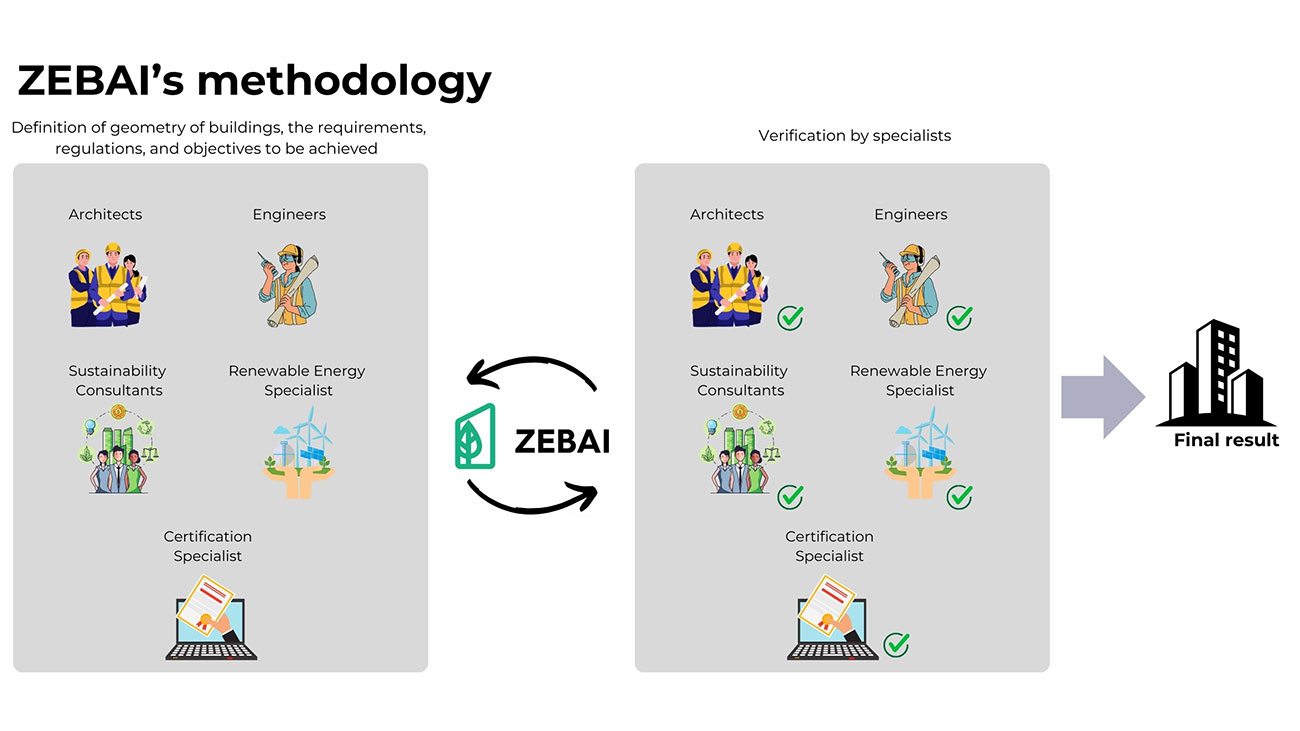
Our team aims to contribute to the decarbonisation of the construction sector by developing a tool and an integrative methodology that facilitates and makes more efficient the design and construction of Zero-emission buildings (ZEB).


Our team aims to contribute to the decarbonisation of the construction sector by developing a tool and an integrative methodology that facilitates and makes more efficient the design and construction of Zero-emission buildings (ZEB).
To this end, a design-assistant tool will help to reduce energy consumption and greenhouse gas emissions during the whole life cycle of the buildings, while improving their indoor environmental quality and making their construction more cost-efficient.
Today, several methodologies and tools are available in the construction sector that address a single analysis objective, e.g., energy efficiency analysis, life cycle analysis, costs, or comfort.
However, a single mitigation strategy cannot effectively enable the objective of delivering cost-effective zero-emissions buildings (ZEBs) neither meeting current and future climate targets. A solution to the crux of ZEB is to tackle multiple fronts in an integrative methodology. It is also clear that collaboration between stakeholders is crucial, as no mitigation strategy is, in fact, a silo in isolation.
The ZEBAI team plans to leverage the potential of new artificial intelligence (AI) technologies to analyse and optimise the multi-criteria design (e.g. energy efficiency analysis, life cycle analysis, costs, maintainability, etc) problem in which competing goals have to be addressed simultaneously.
The ZEBAI team will also be working on offering a free matrial database for the actors active in the field of construction of buildig design.
The ZEBAI team will develop 4 real life demonstrators located in four different climates, and countries with different usage. In addition, different data will be collected during and after the development of these demonstrators to measure the results obtained and the impact of this proposal on the building sector, in line with EU priorities. The impact will not only be studied with respect to the building performance, but also on aspects of how the tool contributes to improving the efficiency and results of the design process.